Question 7
DRAG DROP - (Topic 3)
You have two Fabric notebooks named Load_Salesperson and Load_Orders that read data from Parquet files in a lakehouse. Load_Salesperson writes to a Delta table named dim_salesperson. Load.Orders writes to a Delta table named fact_orders and is dependent on the successful execution of Load_Salesperson.
You need to implement a pattern to dynamically execute Load_Salesperson and Load_Orders in the appropriate order by using a notebook.
How should you complete the code? To answer, drag the appropriate values the correct targets. Each value may be used once, more than once, or not at all. You may need to drag the split bar between panes or scroll to view content.
NOTE: Each correct selection is worth one point.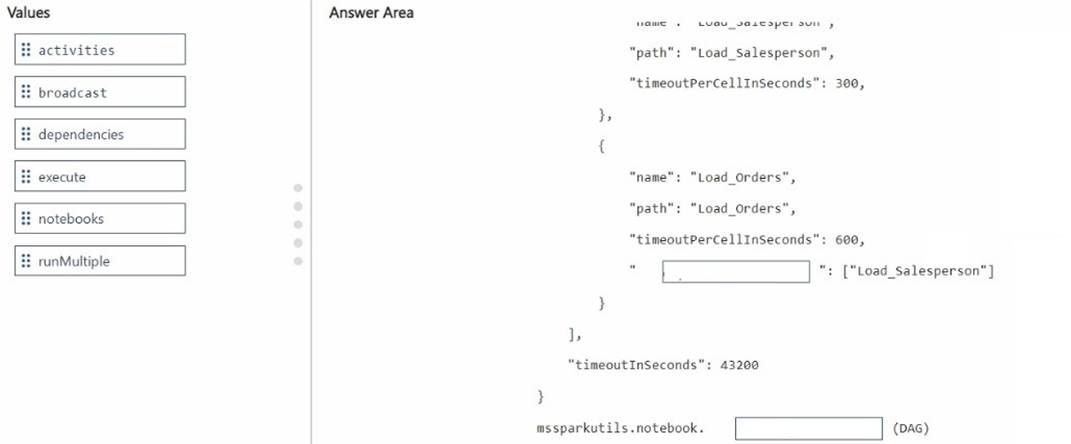
Solution: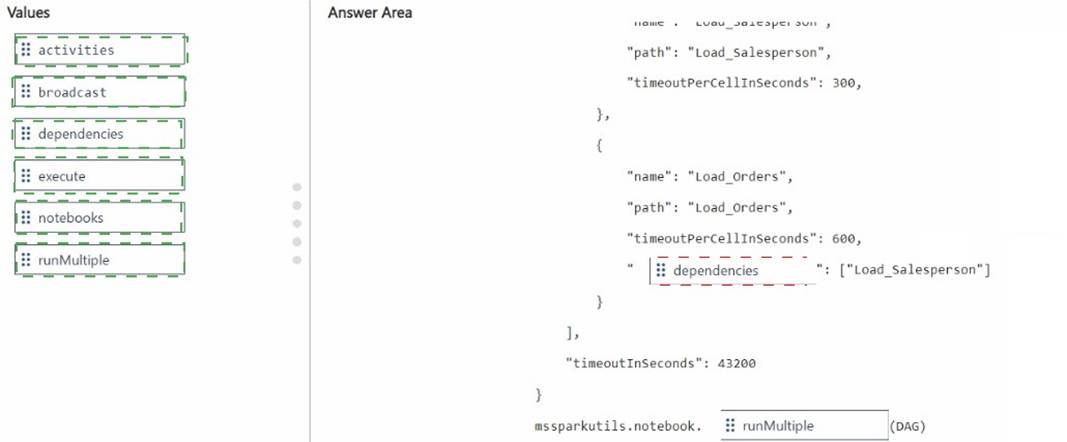
Does this meet the goal?
Correct Answer:A
Question 8
- (Topic 3)
Note: This question is part of a series of questions that present the same scenario. Each question in the series contains a unique solution that might meet the stated goals. Some question sets might have more than one correct solution, while others might not have a correct solution.
After you answer a question in this section, you will NOT be able to return to it. As a result, these questions will not appear in the review screen.
You have a KQL database that contains two tables named Stream and Reference. Stream contains streaming data in the following format.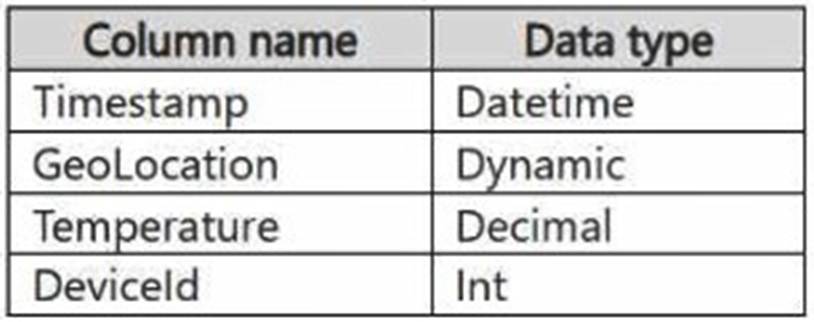
Reference contains reference data in the following format.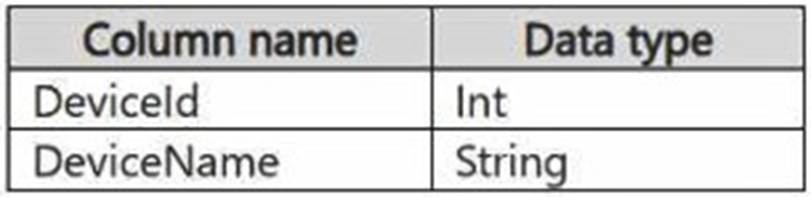
Both tables contain millions of rows. You have the following KQL queryset.
You need to reduce how long it takes to run the KQL queryset. Solution: You add the make_list() function to the output columns. Does this meet the goal?
Correct Answer:B
Adding an aggregation like make_list() would require additional processing and memory, which could make the query slower.
Question 9
DRAG DROP - (Topic 3)
You are building a data loading pattern by using a Fabric data pipeline. The source is an Azure SQL database that contains 25 tables. The destination is a lakehouse.
In a warehouse, you create a control table named Control.Object as shown in the exhibit. (Click the Exhibit tab.)
You need to build a data pipeline that will support the dynamic ingestion of the tables listed in the control table by using a single execution.
Which three actions should you perform in sequence? To answer, move the appropriate actions from the list of actions to the answer area and arrange them in the correct order.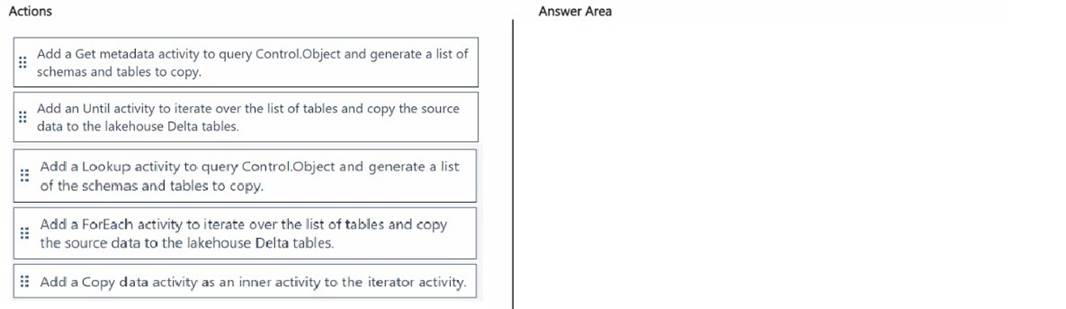
Solution:
Does this meet the goal?
Correct Answer:A
Question 10
- (Topic 3)
You have a Fabric workspace that contains a takehouse and a semantic model named Model1.
You use a notebook named Notebook1 to ingest and transform data from an external data source.
You need to execute Notebook1 as part of a data pipeline named Pipeline1. The process must meet the following requirements:
• Run daily at 07:00 AM UTC.
• Attempt to retry Notebook1 twice if the notebook fails.
• After Notebook1 executes successfully, refresh Model1.
Which three actions should you perform? Each correct answer presents part of the solution. NOTE: Each correct selection is worth one point.
Correct Answer:ACE
Question 11
- (Topic 3)
Note: This question is part of a series of questions that present the same scenario. Each question in the series contains a unique solution that might meet the stated goals. Some question sets might have more than one correct solution, while others might not have a correct solution.
After you answer a question in this section, you will NOT be able to return to it. As a result, these questions will not appear in the review screen.
You have a Fabric eventstream that loads data into a table named Bike_Location in a KQL database. The table contains the following columns:
BikepointID Street Neighbourhood No_Bikes No_Empty_Docks Timestamp
You need to apply transformation and filter logic to prepare the data for consumption. The
solution must return data for a neighbourhood named Sands End when No_Bikes is at least 15. The results must be ordered by No_Bikes in ascending order.
Solution: You use the following code segment:
Does this meet the goal?
Correct Answer:B
This code does not meet the goal because it uses sort by without specifying the order, which defaults to ascending, but explicitly mentioning asc improves clarity.
Correct code should look like:
Question 12
HOTSPOT - (Topic 3)
You have a Fabric workspace that contains a warehouse named Warehouse1. Warehouse! contains a table named Customer. Customer contains the following data.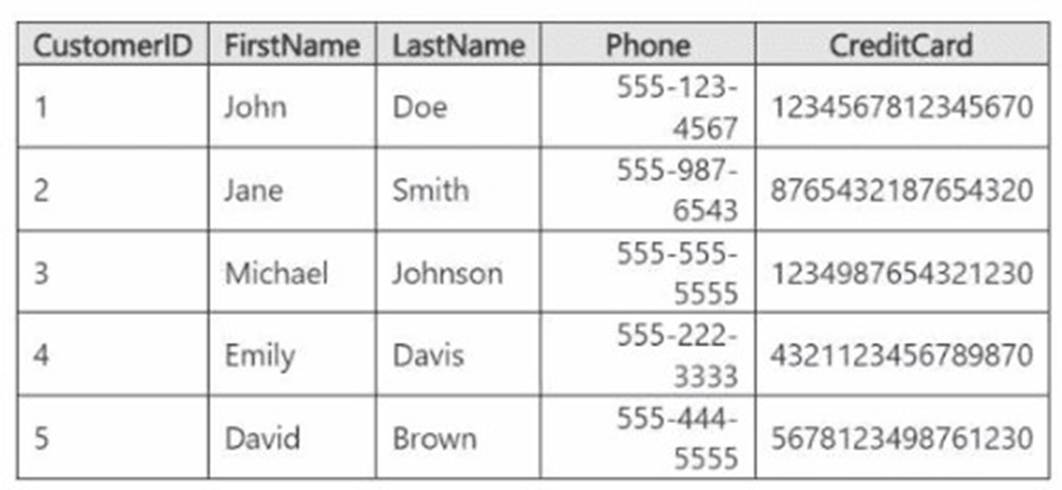
You have an internal Microsoft Entra user named User1 that has an email address of user1@contoso.com.
You need to provide User1 with access to the Customer table. The solution must prevent User1 from accessing the CreditCard column.
How should you complete the statement? To answer, select the appropriate options in the answer area.
NOTE: Each correct selection is worth one point.
Solution: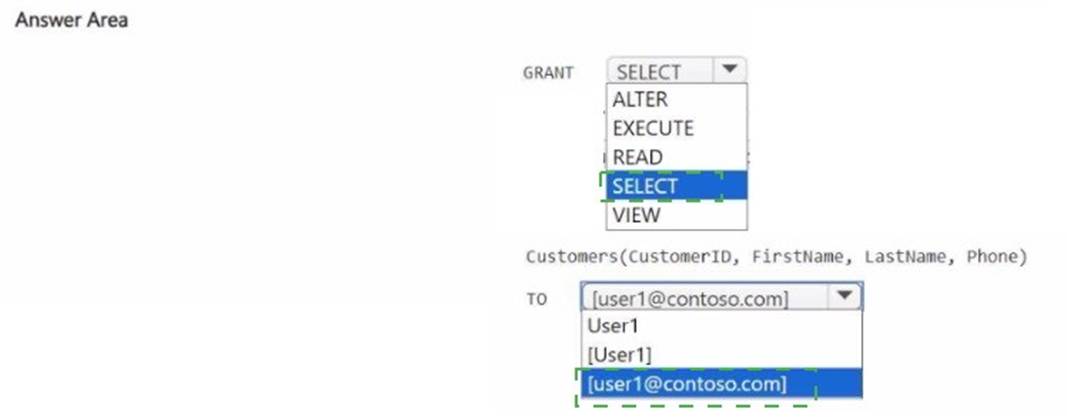
Does this meet the goal?
Correct Answer:A