Online XK0-006 Practice TestMore CompTIA Products >
Free CompTIA XK0-006 Exam Dumps Questions
CompTIA XK0-006: CompTIA Linux+ Exam
- Get instant access to XK0-006 practice exam questions
- Get ready to pass the CompTIA Linux+ Exam exam right now using our CompTIA XK0-006 exam package, which includes CompTIA XK0-006 practice test plus an CompTIA XK0-006 Exam Simulator.
- The best online XK0-006 exam study material and preparation tool is here.
Question 1
A Linux systems administrator is running an important maintenance task that consumes a large amount of CPU, causing other applications to slow. Which of the following actions should the administrator take to help alleviate the issue?
Correct Answer:B
Process scheduling and resource management are essential Linux administration skills covered in Linux+ V8. When a process consumes excessive CPU resources, it can negatively impact overall system performance.
The correct solution is tolower the priorityof the CPU-intensive task using the renice command. Niceness values influence how much CPU time a process receives relative to others. Increasing the niceness value reduces the process??s priority, allowing other applications to receive CPU resources more fairly.
OptionBdirectly addresses the issue. The other options do not. pidstat monitors processes but does not modify CPU allocation. nohup allows a process to continue running after logout but does not affect scheduling priority. bg resumes a stopped job in the background but does not reduce CPU usage.
Linux+ V8 documentation explicitly references nice and renice for managing CPU contention. Therefore, the correct answer isB.
Question 2
A Linux administrator attempts to log in to a server over SSH as root and receives the following error message: Permission denied, please try again. The administrator is able to log in to the console of the server directly with root and confirms the password is correct. The administrator reviews the configuration of the SSH service and gets the following output: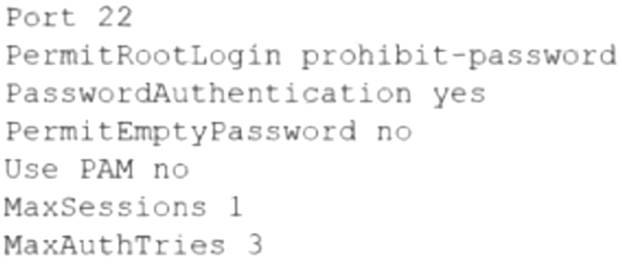
Based on the above output, which of the following will most likely allow the administrator to log in over SSH to the server?
Correct Answer:D
The SSH configuration option PermitRootLogin prohibit-password prevents the root user from logging in with password authentication. This setting means root cannot use a password to log in via SSH; only key- based authentication is permitted for root. The administrator can still log in as root locally, which is not affected by this SSH configuration. To allow SSH access as root, the administrator must use an SSH key instead of a password.
Other options:
* A. MaxSessions controls the number of simultaneous SSH sessions but is not causing the login denial here.
* B. PAM (Pluggable Authentication Modules) is disabled, but enabling it is not required for basic SSH authentication.
* C. Changing the SSH port is unrelated to the authentication method issue.
Reference:
CompTIA Linux+ Study Guide: Exam XK0-006, Sybex, Chapter 11: "Securing Linux", Section: "Securing SSH Access"
CompTIA Linux+ XK0-006 Objectives, Domain 3.0: Security
Question 3
A Linux administrator updates the DNS record for the company using:
cat /etc/bind/db.abc.com
The revised partial zone file is as follows:
ns1 IN A 192.168.40.251
ns2 IN A 192.168.40.252
www IN A 192.168.30.30
When the administrator attempts to resolve www.abc.com to its IP address, the domain name still points to its old IP mapping:
nslookup www.abc.com
Server: 192.168.40.251
Address: 192.168.40.251#53
Non-authoritative answer
Name: www.abc.com
Address: 199.168.20.81
Which of the following should the administrator execute to retrieve the updated IP mapping?
Correct Answer:D
This scenario represents a classic DNS troubleshooting situation covered in the Troubleshooting domain of the CompTIA Linux+ V8 objectives. Although the DNS zone file has been updated correctly on the BIND server, the system continues to resolve the domain name to an outdated IP address. This behavior strongly indicates DNS caching rather than a configuration error in the zone file itself.
Modern Linux systems that use systemd-resolved cache DNS responses locally to improve performance and reduce external queries. Even after a DNS record is updated on the authoritative server, cached results may persist until the cache expires or is manually cleared. The nslookup output showing a non-authoritative answer further confirms that the response is being served from a cache rather than directly from the updated zone data.
The correct solution is to flush the local DNS cache so the system can retrieve the updated record from the DNS server. The command resolvectl flush-caches clears all cached DNS entries maintained by systemd- resolved, forcing fresh queries to authoritative name servers. This aligns directly with Linux+ V8 documentation for resolving name resolution inconsistencies caused by stale cache entries.
The other options are incorrect for the following reasons. systemd-resolve query www.abc.com performs a DNS lookup but does not clear cached entries. systemd-resolve status only displays resolver configuration and statistics. service nslcd reload reloads the Name Service LDAP daemon and is unrelated to DNS resolution or caching.
Linux+ V8 emphasizes identifying whether issues originate from services, configuration, or cached data. In this case, flushing the DNS cache is the correct and least disruptive corrective action.
Therefore, the correct answer is D. resolvectl flush-caches.
Question 4
Which of the following describes PEP 8?
Correct Answer:A
Python scripting is part of Linux automation, and Linux+ V8 includes knowledge of Python development standards. PEP 8 stands for Python Enhancement Proposal 8 and defines the official style guide for Python code.
PEP 8 provides conventions for code layout, indentation, naming, line length, whitespace usage, and commenting. Its purpose is to improve code readability and maintainability, especially in collaborative environments. Linux+ V8 emphasizes that standardized coding practices are critical in automation and DevOps workflows.
The other options are incorrect. Python virtual environments are managed using tools such as venv. Package installation is handled by pip. Octal values are represented using specific syntax and are unrelated to PEP 8.
Therefore, the correct answer is A.
Question 5
A systems administrator needs to enable routing of IP packets between network interfaces. Which of the following kernel parameters should the administrator change?
Correct Answer:D
IP packet forwarding is a key networking function in Linux system management and is explicitly referenced in the Linux+ V8 objectives. Enabling this feature allows a Linux system to act as a router by forwarding packets between network interfaces.
The kernel parameter responsible for this behavior is net.ipv4.ip_forward. When this parameter is set to 1, the Linux kernel allows IPv4 packets to be forwarded between interfaces. By default, this setting is often disabled on non-routing systems for security reasons.
The parameter can be modified temporarily using the sysctl command or permanently by editing /etc/sysctl. conf or files under /etc/sysctl.d/. Linux+ V8 documentation highlights this parameter as essential for configuring routing, NAT, and firewall-based gateway systems.
The other options are incorrect. net.ipv4.ip_multicast controls multicast behavior, not packet forwarding. net. ipv4.ip_route is not a valid kernel parameter. net.ipv4.ip_local_port_range defines the range of ephemeral ports used by outgoing connections and has no effect on routing.
Properly enabling IP forwarding is critical when configuring VPN gateways, firewalls, and network appliances. Therefore, the correct answer is D. net.ipv4.ip_forward.
Question 6
An administrator attempts to install updates on a Linux system but receives error messages regarding a specific repository. Which of the following commands should the administrator use to verify that the repository is installed and enabled?
Correct Answer:D
Package management troubleshooting is an important skill in Linux+ V8, especially on RPM-based distributions that use yum or dnf. When update errors reference a repository, the administrator must verify whether the repository exists and whether it is enabled.
The command yum repolist all displays all configured repositories, including those that are enabled, disabled, or temporarily unavailable. This makes it the most effective command for diagnosing repository-related issues. It allows administrators to quickly confirm the repository??s status and take corrective action, such as enabling it or fixing configuration errors.
The other options are incorrect. yum repo-pkgs manages packages within a repository but does not list repository status. yum list installed repos is not a valid yum command. yum reposync is used to mirror repositories locally and is not intended for verification.
Linux+ V8 documentation highlights yum repolist all as the standard command for repository inspection and troubleshooting.
Therefore, the correct answer is D. yum repolist all.