Online JN0-637 Practice TestMore Juniper Products >
Free Juniper JN0-637 Exam Dumps Questions
Juniper JN0-637: Security - Professional (JNCIP-SEC)
- Get instant access to JN0-637 practice exam questions
- Get ready to pass the Security - Professional (JNCIP-SEC) exam right now using our Juniper JN0-637 exam package, which includes Juniper JN0-637 practice test plus an Juniper JN0-637 Exam Simulator.
- The best online JN0-637 exam study material and preparation tool is here.
Question 1
You configured two SRX series devices in an active/passive multimode HA setup. In this scenario, which statement is correct?
Correct Answer:D
Question 2
You are using AutoVPN to deploy a hub-and-spoke VPN to connect your enterprise sites. In this scenario, which two statements are true? (Choose two.)
Correct Answer:AC
Question 3
Referring to the exhibit,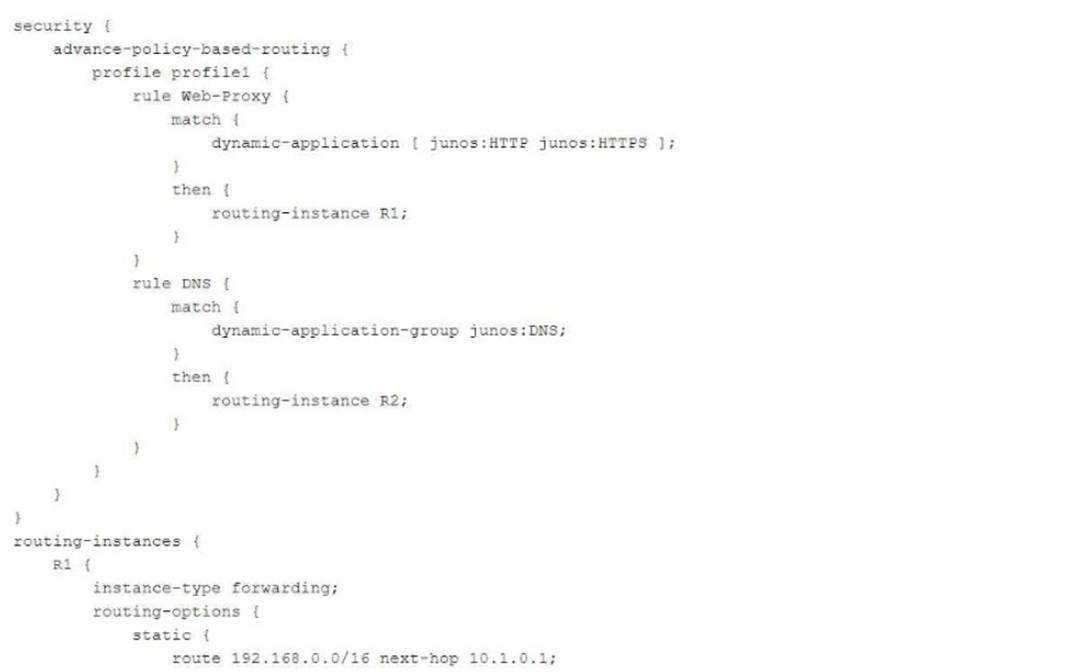
which statement about TLS 1.2 traffic is correct?
Correct Answer:A
Question 4
You are setting up multinode HA for redundancy.
Which two statements are correct in this scenario? (Choose two.)
Correct Answer:AC
Comprehensive Detailed Step-by-Step Explanation with All Juniper Security References
Understanding Multinode HA:
✑ Chassis Cluster in Active/Passive Mode:
✑ Dynamic Routing Protocols:
Option A: Dynamic routing is active on one device at a time.
✑ Explanation:
Reference:
"In a chassis cluster, the primary node handles all control plane tasks, including dynamic routing."
Source: Juniper TechLibrary - Chassis Cluster Overview
Option C: Physical connections are used for the control and fabric links.
* Explanation:
Control and fabric links are direct physical connections between cluster nodes.
Reference:
"The control and fabric links must be connected using physical interfaces between the nodes."
Source: Juniper TechLibrary - Chassis Cluster Components
Why Options B and D are Incorrect:
Option B: Dynamic routing is not active on both devices simultaneously in active/passive mode.
Option D: The Inter-Cluster Link (ICL) uses Layer 2 connectivity, not Layer 3.
Conclusion:
The correct options are A and C.
Question 5
Click the Exhibit button.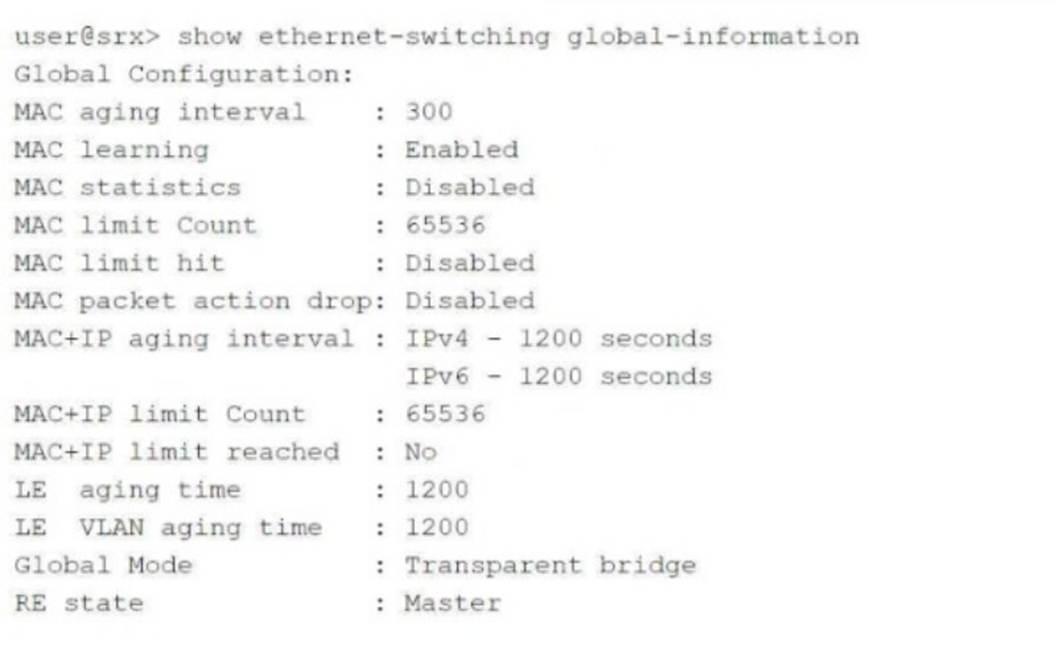
Referring to the exhibit, which two statements are correct? (Choose two.)
Correct Answer:AD
Comprehensive Detailed Step-by-Step Explanation with All Juniper Security References
Understanding the Exhibit:
✑ The SRX device is operating in Transparent Mode, as indicated by:
Transparent Mode on SRX Devices:
✑ Transparent Mode (Layer 2 Mode):
✑ Option A: You cannot secure intra-VLAN traffic with a security policy on this
device.
✑ Option B: You can secure inter-VLAN traffic with a security policy on this device.
✑ Option C: The device can pass Layer 2 and Layer 3 traffic at the same time.
✑ Option D: The device cannot pass Layer 2 and Layer 3 traffic at the same time.
Key Points:
✑ Intra-VLAN Traffic:
✑ Inter-VLAN Traffic:
Juniper Security References:
✑ Juniper Networks Documentation:
Conclusion:
✑ Option A is correct because intra-VLAN traffic cannot be secured with security policies in Transparent Mode.
✑ Option D is correct because the device cannot pass both Layer 2 and Layer 3 traffic at the same time when operating in Transparent Mode.
Question 6
Which two statements are true regarding NAT64? (Choose two.)
Correct Answer:AD
Comprehensive Detailed Step-by-Step Explanation with All Juniper Security References
Understanding NAT64:
✑ NAT64 allows IPv6-only clients to communicate with IPv4 servers by translating IPv6 addresses to IPv4 addresses and vice versa.
✑ It is essential in environments where IPv6 clients need access to IPv4 resources.
Flow-Based vs. Packet-Based Forwarding Modes:
✑ Flow-Based Forwarding Mode:
✑ Packet-Based Forwarding Mode:
✑ Option A: An SRX Series device should be in flow-based forwarding mode for IPv4.
✑ Option B: An SRX Series device should be in packet-based forwarding mode for
IPv4.
✑ Option C: An SRX Series device should be in packet-based forwarding mode for IPv6.
✑ Option D: An SRX Series device should be in flow-based forwarding mode for
IPv6.
Key Points:
✑ NAT64 Requires Flow-Based Mode:
✑ Packet-Based Mode Limitations:
Juniper Security References:
✑ Juniper Networks Documentation:
✑ Understanding Flow-Based and Packet-Based Modes:
Conclusion:
✑ To implement NAT64 on an SRX Series device, both IPv4 and IPv6 traffic must be processed in flow-based forwarding mode.
✑ Therefore, Options A and D are the correct statements.